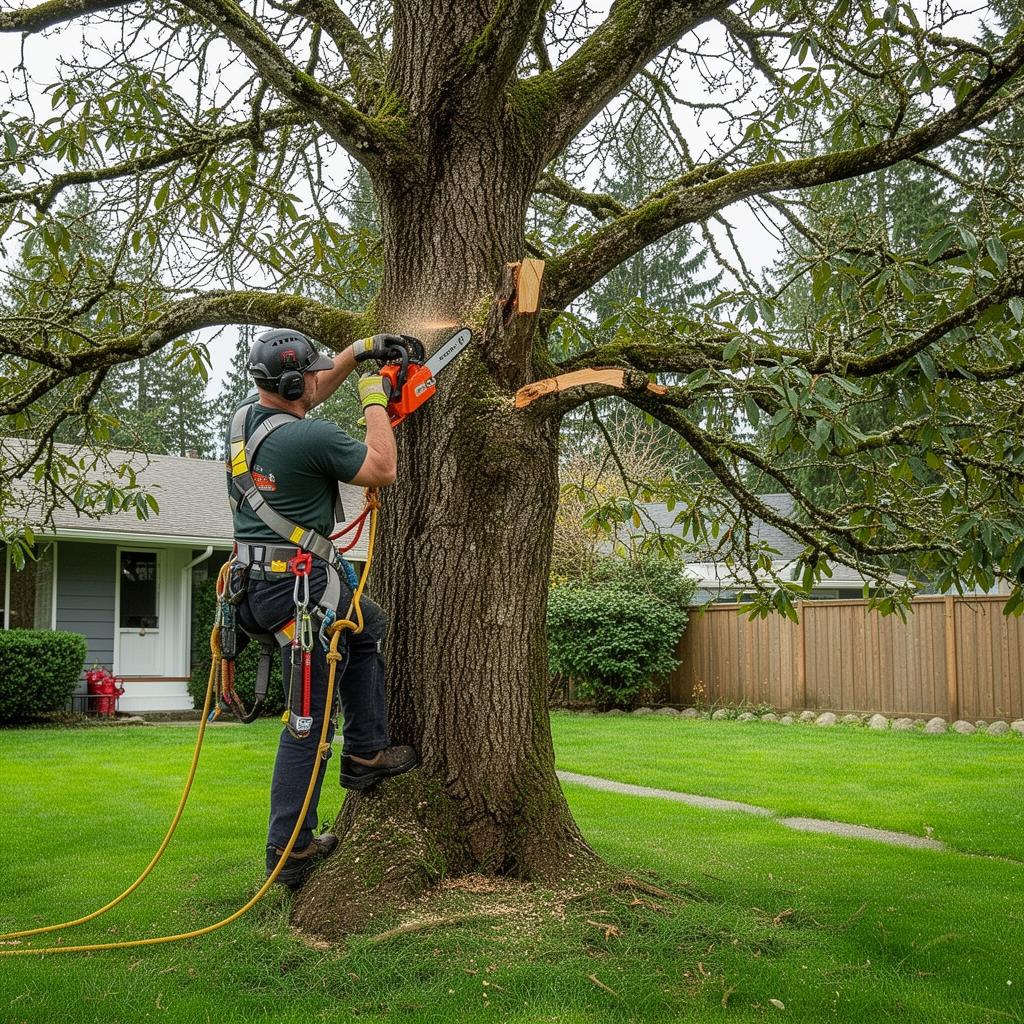
Done right, tree trimming and pruning extends the life of your Bellevue trees, reduces storm-failure risk, and keeps your property safe and attractive. Done wrong, it shortens tree life and invites decay. Bellevue Elite Tree Service uses ISA-standard cuts — never topping — to deliver pruning that protects long-term tree health.
Types of pruning we do across Bellevue
Crown thinning selectively removes interior branches to reduce wind load and improve light penetration — essential for the dense Douglas firs and western red cedars that dominate the Eastside canopy. Crown raising lifts the lowest branches to clear roofs, driveways, and sightlines. Deadwood removal eliminates safety hazards and reduces decay pathways. Structural pruning on young trees prevents the co-dominant unions and included bark that cause failures decades later.
Each species needs a different approach. Maples bleed heavily if pruned in late winter. Flowering cherries should be pruned right after bloom. Conifers tolerate dormant-season work well. We schedule each species at the right time to protect long-term health.
Why proper cuts matter in the Pacific Northwest
Our wet climate is brutal on poor pruning. A flush cut or a stub-cut left behind in October will be colonized by decay fungi by spring, and the damage can take five to ten years to show up as a hollow union or a dead limb. ISA-standard cuts are made just outside the branch collar, preserving the tree's natural defense barrier. Topping — cutting major branches back to arbitrary points — is the worst thing you can do to a Bellevue tree. It triggers weak epicormic regrowth, accelerates decay, and creates the structural defects that lead to failure in the next windstorm.
If a previous contractor topped your trees, we can often help with restorative pruning over several years to rebuild a more durable structure.
When to trim trees in Bellevue
Late summer through early winter is typically best for major pruning on broadleaf species because wound closure is rapid and disease pressure is lower. Conifers can be worked through most of the year. Avoid heavy pruning during spring leaf-out when energy reserves are at their lowest. Emergency or safety pruning, of course, happens whenever it's needed.
A general rule for mature Bellevue trees: never remove more than 25 percent of the live crown in a single year, and ideally far less on older specimens. Aggressive pruning is a slow-motion stressor that shows up years later as decline.
What Bellevue tree trimming costs
Small trees (under 30 feet): $200–$500. Medium trees (30–60 feet): $500–$1,000. Large trees (60+ feet): $1,000–$2,000. Pricing depends on access, complexity, and how much the tree needs. Every quote is free and itemized, and we'll often bundle multiple trees on a single mobilization to reduce per-tree cost.